
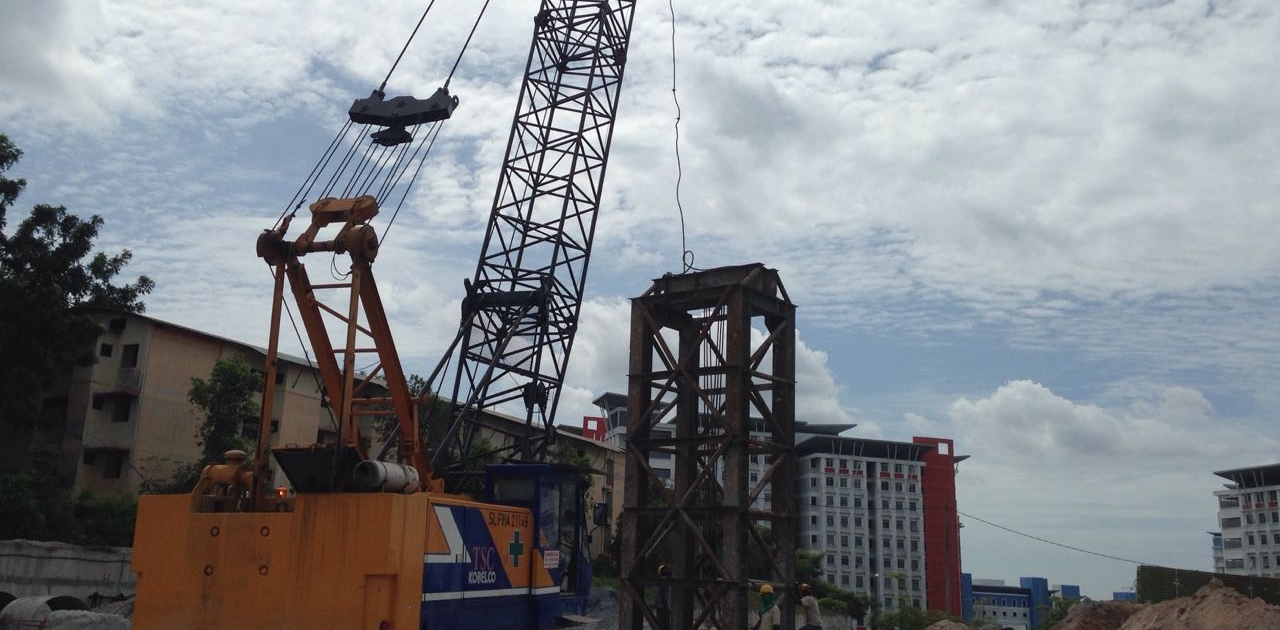
Pile & Foundation Testing
Foundtest (M) Sdn Bhd provides pile and foundation testing services throughout Malaysia, verifying that installed piles can safely carry their design load before construction proceeds. Since 2004 we have tested in excess of 50,000 piles across more than 2,000 projects nationwide.
Pile testing is required to confirm two things: that a pile has adequate bearing capacity, and that it is structurally sound and free of defects. Different tests answer different questions, and most projects use a combination.
Capacity Testing
The Pile Dynamic Load Test (PDA) is a high-strain dynamic test carried out to ASTM D4945, using strain transducers and accelerometers mounted near the pile head to measure force and velocity under hammer impact. CAPWAP signal matching analysis then separates shaft friction from toe resistance. The Maintained Load Test (MLT) applies static load in increments and is the reference method where a direct static verification is specified.
Integrity Testing
The Pile Integrity Test (PIT) is a low-strain method that detects necking, cracking, soil inclusions and changes in cross-section along the pile shaft. Sonic Logging (Cross-Hole Sonic Logging) is used on bored piles with pre-installed access tubes, and gives a more detailed picture of concrete quality across the full pile length.
Which Pile Test Do You Need?
PDA is the most common choice for verifying working and ultimate capacity because it is fast and economical relative to static testing. PIT is typically applied across a percentage of piles as a routine integrity screen. Sonic Logging is specified for large-diameter bored piles. MLT is used where a specification or authority requires static load verification.
All test reports are prepared for submission to consulting engineers, main contractors and government authorities including JKR.
Pile Testing FAQ
What is pile testing and why is it required?
Pile testing verifies that installed foundation piles can carry their design load safely and are free of structural defects. It is normally required by the consulting engineer or authority before superstructure works proceed.
Which pile test is most commonly used in Malaysia?
The Pile Dynamic Load Test (PDA) is the most widely used capacity test, as it provides shaft and toe capacity quickly and at lower cost than static load testing.
What is the difference between PDA and Pile Integrity Test?
PDA is a high-strain test that measures pile bearing capacity. PIT is a low-strain test that checks pile integrity and detects defects, but does not measure capacity.
How soon after piling can testing be carried out?
Timing depends on pile type and concrete strength gain. For driven and bored concrete piles, testing is generally carried out once the concrete has reached adequate strength and any required set-up period has elapsed.
Do you provide reports for JKR submission?
Yes. Reports are prepared for submission to consulting engineers, main contractors and government authorities including JKR.