
Pile Dynamic Load Test (PDA)
The Pile Dynamic Load Test (PDA) is a high-strain dynamic load test used to determine the bearing capacity and structural integrity of a foundation pile. Foundtest (M) Sdn Bhd has carried out PDA testing throughout Malaysia since 2004, on projects ranging from residential and commercial developments to infrastructure and industrial works.
 PDA test in progress on site
Foundtest (M) Sdn Bhd specialises in high-strain dynamic load testing, analysis and consulting services for the piling industry. Testing is carried out on site by trained and experienced engineers using a Pile Driving Analyzer, with data analysed using the Case Pile Wave Analysis Program (CAPWAP) to assess pile behaviour.
Expert Level Certified Operator
Foundtest’s PDA testing is led by an engineer certified at Expert level in the Dynamic Measurement & Analysis Proficiency Test, administered jointly by the Pile Driving Contractors Association (PDCA) and Pile Dynamics, Inc. (PDI).
Expert is the highest of six proficiency ranks, and is currently the only Expert-level certification held in Malaysia. Unlike the lower ranks, Expert certification does not expire. Certification can be verified on the official PDCA / Pile Dynamics public register.
How the PDA Test Works
The test is carried out in accordance with ASTM D4945. Strain transducers and accelerometers are bolted to the pile near the pile head to record force and velocity as a hammer impact is applied. The Pile Driving Analyzer captures each blow and computes capacity in real time on site.
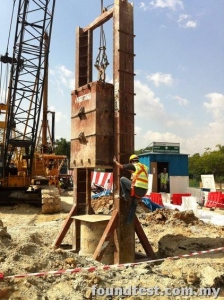 Foundtest Drop Hammer System for PDA Test
Recorded data is then processed using CAPWAP signal matching analysis, which separates total resistance into shaft friction and toe resistance, and produces a simulated static load-settlement curve. This allows mobilised capacity, pile integrity and driving stresses to be assessed from a single test.
Dynamic pile testing has been used in the industry for over 30 years. Because it is faster and more economical than static load testing, it has become the routine method of verifying pile capacity on most projects, with ASTM D4945 providing the governing standard.
What the PDA Test Measures
- Ultimate and mobilised pile bearing capacity
- Distribution of shaft friction and toe resistance
- Pile integrity and detection of damage along the shaft
- Maximum compressive and tensile driving stresses
- Hammer energy transferred to the pile
- Simulated static load-settlement behaviour via CAPWAP
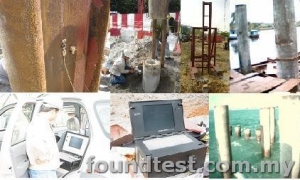
Pile Types We Test
Foundtest carries out PDA testing on all pile types, including driven reinforced concrete piles, spun piles, bored cast in-situ piles, micropiles, steel H-piles, steel pipe piles, raked piles and jack-in piles.
Why PDA Instead of Static Load Testing
A Maintained Load Test provides direct static verification, but requires kentledge or reaction piles and takes considerably longer to set up and complete. PDA testing produces capacity results in a fraction of the time and cost, which makes it practical to test a larger proportion of piles on a project. Many specifications use PDA as the routine capacity test, with a limited number of static tests for correlation.
PDA Test FAQ
What is a PDA test?
A PDA test, or Pile Dynamic Load Test, is a high-strain dynamic test that measures the bearing capacity and integrity of a foundation pile by recording force and velocity during a hammer impact, in accordance with ASTM D4945.
What standard is the PDA test carried out to?
PDA testing is carried out in accordance with ASTM D4945, Standard Test Method for High-Strain Dynamic Testing of Deep Foundations.
What is CAPWAP analysis?
CAPWAP is a signal matching analysis applied to PDA data. It separates the total measured resistance into shaft friction and toe resistance, and produces a simulated static load-settlement curve for the pile.
How many piles should be tested?
The number of piles tested is set by the consulting engineer or the project specification. A percentage of the total pile count is commonly specified, with test piles selected to represent different pile sizes, lengths and ground conditions across the site.
Can PDA testing be used on bored piles?
Yes. PDA testing can be carried out on bored cast in-situ piles as well as driven piles, provided a suitable drop hammer arrangement and pile head preparation are available.
Is a PDA test accepted for JKR projects?
Yes. PDA test reports are prepared for submission to consulting engineers, main contractors and government authorities including JKR.
For more information, a quotation or to arrange a site appointment, please call us or drop us a message here.
Existing clients may download the complete Method Statement / Technical Specification for the Pile Dynamic Load Test (PDA) here.